

Space exploration is one of humanity's most ambitious endeavors, pushing the boundaries of technology and science to uncover the mysteries of the cosmos. At its core, space exploration relies heavily on physics to design spacecraft, navigate vast distances, and sustain missions in the harsh environment of space. Let's explore the key physics principles that make space exploration possible.
Rocket Propulsion: Newton's Third Law in Action
The journey to space begins with rocket propulsion, which operates on the principle of Newton's Third Law of Motion: "For every action, there is an equal and opposite reaction." Rockets expel gas at high speeds in one direction, producing thrust in the opposite direction. This thrust must overcome Earth's gravitational pull to achieve escape velocity — approximately 11.2 kilometers per second (about 25,000 miles per hour).
The efficiency of propulsion systems has been enhanced through innovations like liquid-fuel engines, which allow for precise control, and ion propulsion, which uses charged particles to generate thrust for long-duration missions.
Gravitational Assists: Slingshots Through Space
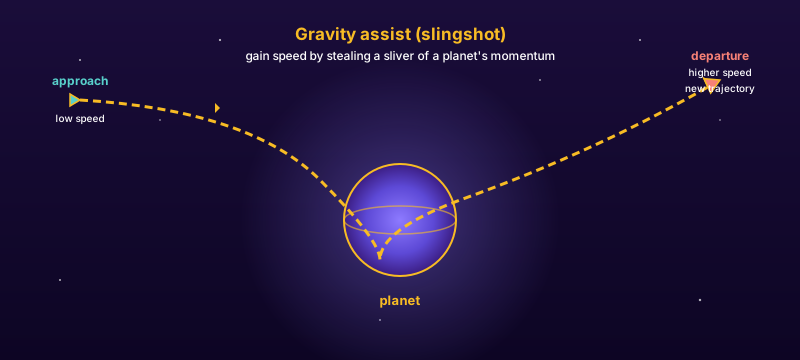
Gravitational assists, or slingshots, are a clever application of orbital mechanics. Spacecraft use the gravitational pull of planets or moons to gain speed and alter their trajectory without expending additional fuel. By passing close to a celestial body, the spacecraft "steals" a small amount of momentum, accelerating toward its destination.
This technique has been vital for missions like the Voyager probes, which used gravitational assists to explore the outer planets and beyond.
Orbital Mechanics: Staying in Space
To stay in orbit around Earth or any celestial body, a spacecraft must achieve a precise balance between its velocity and the pull of gravity. This balance is governed by Kepler's laws of planetary motion and Newton's law of universal gravitation.
Low Earth orbit (LEO) missions, like those of the International Space Station (ISS), maintain an altitude where Earth's gravity keeps the spacecraft in a circular or elliptical path. For interplanetary missions, trajectories are meticulously calculated to align with the orbits of target planets, minimizing fuel consumption and travel time.
Thermodynamics: Battling the Extremes of Space
Spacecraft must endure extreme temperatures, from the intense heat of the Sun to the freezing cold of deep space. Physics principles, particularly thermodynamics, guide the development of thermal control systems. Reflective coatings, radiators, and insulating materials like aerogel are used to regulate temperature and protect sensitive instruments.
For example, the James Webb Space Telescope employs a sunshield made of multiple layers of reflective material to keep its instruments cool while observing distant galaxies.
Radiation Protection: Shielding Against Cosmic Hazards
Beyond Earth's atmosphere, space is filled with harmful cosmic radiation and energetic particles from the Sun. Physics helps design shielding to protect astronauts and equipment. Materials like polyethylene and advanced composites absorb or deflect radiation, while magnetic shielding — still in experimental stages — offers the potential to create a protective field similar to Earth's magnetosphere.
Relativity and GPS in Space
Einstein's theory of relativity plays a critical role in space exploration, especially in navigation systems like GPS. The satellites that provide GPS signals experience both time dilation due to their speed (special relativity) and the effects of weaker gravity at higher altitudes (general relativity). These relativistic effects are accounted for in GPS calculations to ensure accuracy in positioning and timing.
The Physics of Landing and Returning
Landing on celestial bodies and returning to Earth involve complex physics calculations. Entry, descent, and landing systems rely on principles of aerodynamics and energy dissipation to ensure a safe touchdown. For example, parachutes, retro-thrusters, and heat shields are designed to counteract the intense heat and forces of atmospheric reentry.
Advancing Our Understanding Through Physics
Physics not only enables space exploration but also expands our knowledge of the universe. From studying the gravitational waves predicted by Einstein to exploring exoplanets' atmospheres, the principles of physics guide discoveries that redefine our understanding of reality.
Space exploration stands as a testament to the power of physics in solving complex challenges and pushing humanity beyond its earthly boundaries. As we continue to explore further into the cosmos, the principles of physics will remain at the heart of every technological breakthrough and discovery. The stars are no longer out of reach — they are the next step in our journey of exploration and innovation.