

Quantum mechanics is one of the most fascinating branches of physics, offering insights into the very fabric of reality. Although it can seem daunting at first, the core ideas are both intriguing and accessible with a bit of explanation. Let's take a simple dive into quantum mechanics and explore some of its key concepts.
What is Quantum Mechanics?
Quantum mechanics is the study of the behavior of matter and energy on the smallest scales — atomic and subatomic particles. Unlike classical physics, which explains the macroscopic world around us, quantum mechanics reveals that the microscopic world behaves in strange and unexpected ways.
Wave-Particle Duality: The Dual Nature of Reality
One of the most famous discoveries in quantum mechanics is wave-particle duality. Particles like electrons and photons (light particles) can act like particles (tiny localized objects) or waves (spread-out patterns of energy), depending on how they are observed.
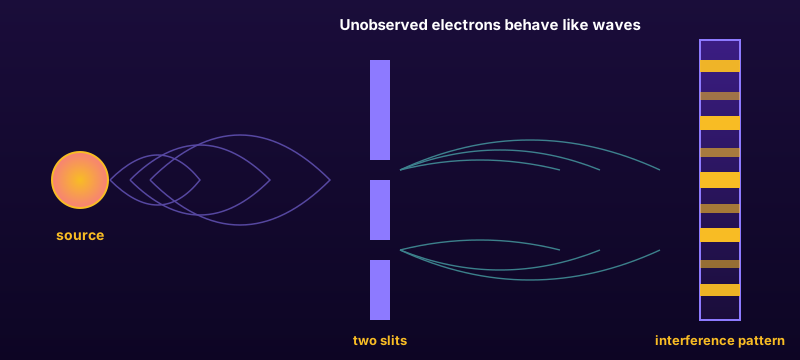
This was demonstrated in the double-slit experiment, where light and electrons created interference patterns when not observed, behaving like waves. But when observed, they acted like particles, hitting only one spot at a time. This dual behavior is a cornerstone of quantum theory, challenging our classical understanding of matter and light.
Schrödinger's Cat: A Thought Experiment
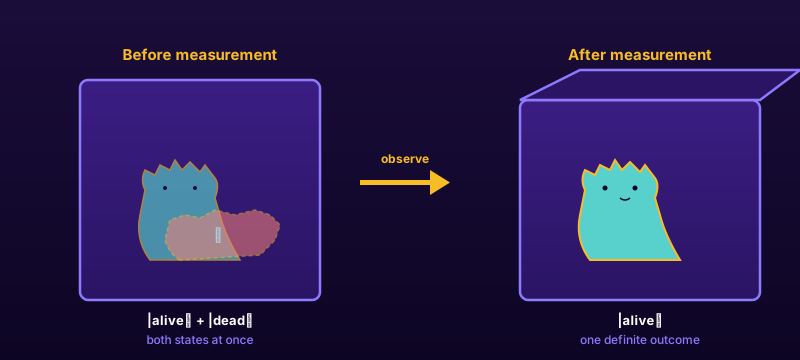
Austrian physicist Erwin Schrödinger proposed a famous thought experiment to illustrate the weirdness of quantum mechanics. Imagine a cat placed in a sealed box with a mechanism that could release poison if a radioactive atom decays. According to quantum mechanics, until the box is opened, the atom's state is a superposition of decayed and not decayed.
This thought experiment highlights the concept of superposition, where particles exist in multiple states at once until measured or observed.
Quantum Superposition and Entanglement
Superposition allows particles to exist in a blend of states. For example, an electron can spin clockwise and counterclockwise simultaneously. This is resolved only when a measurement is made, forcing the electron into a definite state.
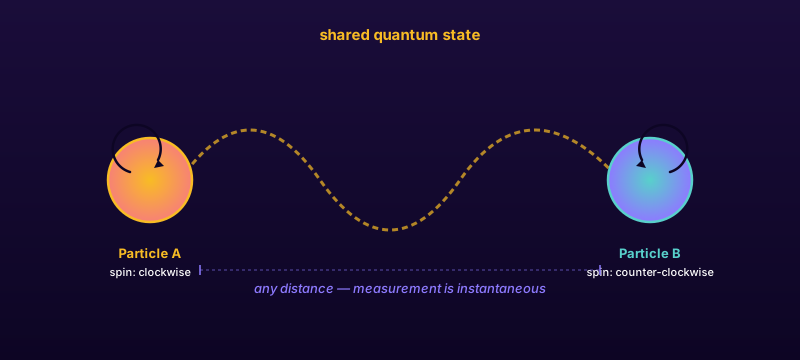
Quantum entanglement is another mind-boggling phenomenon where two particles become linked, so the state of one immediately influences the other, regardless of the distance between them. Albert Einstein famously called this "spooky action at a distance," and it is a key principle behind technologies like quantum computing.
Why Does Quantum Mechanics Matter?
Quantum mechanics isn't just theoretical; it has practical applications that power much of modern technology. It explains how transistors in your computer work, how lasers function, and even how GPS maintains accuracy. Emerging fields like quantum computing and quantum cryptography promise revolutionary advances in technology, healthcare, and communication.
Making Quantum Mechanics Simple
The beauty of quantum mechanics lies in its ability to challenge our perceptions of reality. While it may feel abstract, its principles have concrete effects in our everyday lives. You don't need to be a physicist to appreciate its wonders — understanding just a few core concepts opens the door to a deeper appreciation of the universe.
Quantum mechanics may seem strange, but it's a testament to the complexity and elegance of nature. By embracing its mysteries, we gain a richer understanding of how the universe works on the tiniest of scales. Whether you're curious about its weirdness or its practical uses, quantum mechanics invites us to think beyond the ordinary.